Chaining: Making Connection
By Eric Kastan, M.A.,LMFT, BCBA
Linking it all together
Happy New Year! New year, new skills. In ABA we can build new skills in a couple ways. Shaping was in last month’s blog. This month, we will look into chaining. Chaining is a great procedure to build new skills. This procedure teaches new behaviors and skills in a scripted and planned manner that also offers structure for you as a parent (or educator, or therapist, or caretaker). As you read this, think about a fence; small chain links that ultimately build a strong, sturdy structure.
To build this structure of a new skill or behavior, just like in architecture, we need a guide or blue prints. The first step is to create the blue prints, which ABA calls a task analysis. Once the new skill/behavior that is going to be taught is picked (shoe tying, dish washer, laundry, etc…), you would start by breaking down the individual steps and sequence of this behavior. This list is the task analysis. To verify accuracy, do the behavior yourself and write down each step. Ask others if they agree on the sequence, or seek out an expert to concur as well. After you establish the list is correct, you can start building this new skill.
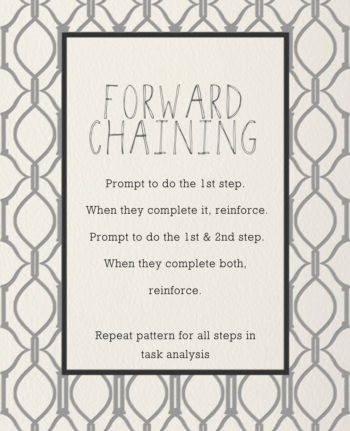
Remember that repetition is key, and the task analysis list will always be taught the same way, start to finish. To start, each step is prompted and modeled to your child, thus creating the links in the chain. Then the procedure of chaining takes this to a higher level.
As I mentioned, the above explanation was forward chaining. There is another form of chaining, backward chaining, which is starting at the last step and working mastery back to the first step. Both styles of chaining are great because your child is built up with steps to master, while still earning reinforcement.
At FACT, we not only incorporate ABA in our home programs, but also bring in other techniques. This is not the classic, no feeling ABA. We are open to many thoughts and interventions. We customize a program to you and your family’s needs.