The ABA Prompt Hierarchy
By Eric Kastan, M.A., LMFT, BCBA
It’s Not What You Say, But How You Say It
As we travel along the path of ABA, it is important to look at your part in the equation of behavior change. February brings a holiday about expressing to your loved ones how you feel about them. Sometimes this can be gigantic, over the top, experiences, and other times it can be a simple little message. Both have meaning and both can deeply affect the other person. The way we express items can affect how they are received, and in turn the other person’s behavior. In ABA when we express to someone that they need to do something, we are giving them a prompt. Prompts can be given in many different ways and degrees. This is called the prompt hierarchy.
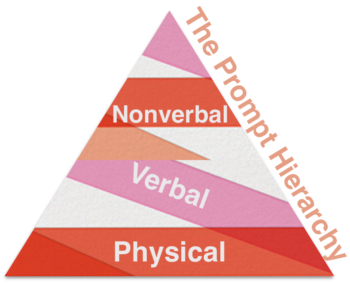
When telling someone what to do (a prompt), we need to examine the level we deliver it (prompt hierarchy). The most restrictive and intensive prompt that can be given is a physical prompt. An example of this is hand over hand writing, when you hold the hand of someone else and help move their hand in the direction you want it to go. Many people are taught basic writing, feeding, and dressing this way. As we move up the scale, the next level is the verbal prompt. Verbal prompts are the most widely used. When you give a mand (ABA term for a direction, command, reprimand), you are using a verbal prompt, like when you tell someone to put their shoes in their room. The next level up is the non-verbal prompt. This is generally the top, least restrictive and intrusive, form of a prompt we have. This includes pointing, visual (pictorial or written) messages, checklists, etc… Emails and texts would also be included here. When you leave a note for someone with a list of chores you want completed before the end of the day, or a calendar on the wall with specific items and times to be done, or stand across the room and point to someone to be quiet and listen to the adult (teacher, parent, etc…), are all examples of non-verbal prompts.
Why is the hierarchy so important? If you do not present your prompt at the “correct” level, the person receiving the prompt may not understand it, or it may be too challenging/easy, or not complete the action. When starting with prompt hierarchy we need to assess the correct level to the individual receiving the prompt. If a prompt is too low (i.e. using physical when the individual can feed him/herself), it does not allow them to grow the skills needed or be independent. If a prompt is too high, using non-verbal, but the individual does not have the abilities to do prompt, (i.e. pointing at pencil then the paper to do homework but they do not know what the directions are), then task completion and accuracy become issues; also the chance of failure increases. The trick is finding the correct level for each behavior, for that individual. This allows them enough support to be challenged and grow while not being stagnate. Sometimes the individual may appear not to understand higher levels, as it is easier for you to tie their shoes than for him/herself to tie them. This is why looking at the balance of the hierarchy and testing it is needed. Pulling away and seeing what the individual can do, can change it all, and more meaning can be found. However, if done wrong the results can have heavy consequences. This is why it is important to have professional guidance when using theses interventions.