Skill Sets for Success: Preparing Students with Autism Spectrum Disorder for College and Beyond
By Sarita Freedman, PhD; FACT Board Member
High functioning (HF) individuals with ASD are found in all walks of life, from high powered careers to significantly underemployed.
What we’ve learned about this population of individuals over the past 15 years is that they have the ability to assimilate and function well, but that in order to do so, they need specific supports and guidance—the earlier the better. What can we do to improve the overall outcome of their endeavors so that they too, can become contributing members of society?
Currently, the sole focus on academics in elementary, middle, and high school for these students actually does them a disservice. Students who are “fully included” in general education classes typically do not receive specific instruction in independence and daily living skills, yet they struggle the most in these areas when they leave high school. Incorporating both academic and life skills into the student’s overall programming—including their school program—will better prepare them to succeed both academically and independently.
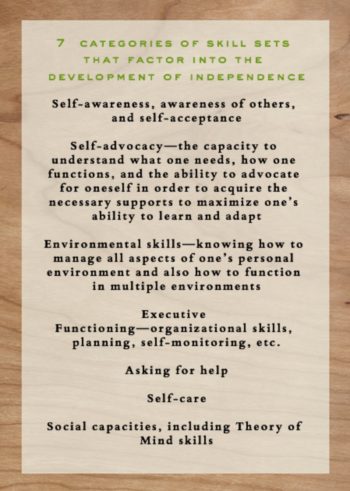
There are seven broad categories of skill sets that factor into the development of overall self-management and independence. The seven broad categories are:
- Self-awareness, awareness of others, and self-acceptance
- Self-advocacy—the capacity to understand what one needs, how one functions, and the ability to advocate for oneself in order to acquire the necessary supports to maximize one’s ability to learn and adapt
- Environmental skills—knowing how to manage all aspects of one’s personal environment and also how to function in multiple environments
- Executive Functioning—organizational skills, planning, self-monitoring, etc.
- Asking for help
- Self-care
- Social capacities, including Theory of Mind skills
Within each broad category there are a number of specific skills that can be taught in developmentally appropriate ways beginning as early as diagnosis and continuing throughout the child’s life. Ideally, the student’s intervention programs will be coordinated between the family, school and the student’s natural environments. This offers the student many opportunities for practice, which facilitates generalization of learning. Preparation and practice over the course of the student’s elementary, middle and secondary education will go a long way towards improving the potential for a positive transition to adulthood.
—
Dr. Sarita Freedman is a licensed psychologist in Calabasas, CA. She specializes in working with individuals of all ages who are affected by autism spectrum disorders, and their family members. She is the author of Developing College Skills in Students with Autism & Asperger’s Syndrome. For more information you can go to her website www.saritafreedman.com, check out her Facebook, and follow her on Twitter @SaritaFreedman.