Reflecting on the Past
Mikal Britt, Behaviorist 10+ years
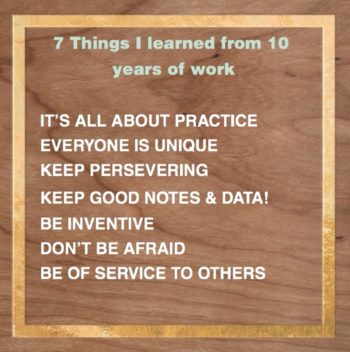
When I started working at FACT ten years ago, I knew basically nothing about autism, therapy or social work. And although I wasn’t aware of it, certain natural parts of my personality and intuition made me a good fit for the field. So I owe a big thank you to FACT for hiring me, for seeing this potential in me. For opening the door and allowing me the opportunity to grow and explore a new direction in my life. This September, I am starting my grad program at Cal State LA to earn my master’s degree in social work. As I say goodbye to FACT, I want to take the time to reflect on some of the things I learned over the years while working here.
1) IT’S ALL ABOUT PRACTICE
Nothing is one size fits all. Whether it’s finding what behavior/therapeutic strategy will work best or finding the right fit of therapist and client, one has to remain open and observant. Because it will be different every time. Just because one thing or person worked before, doesn’t guarantee it will work again in the same way. What’s the point of knowing or understanding this? It means there are no dead ends, just different options to try. So keep trying.
2) EVERYONE IS UNIQUE
Along the lines of number one (and also a topic I have written about in previous newsletters), an individual on the spectrum is a completely unique individual, just like anyone you meet in life. The condition of autism is so vast, there is no simple definition or categorization to confine people. Although there are many similarities and parallels amongst the many clients I have worked with, a good therapist will approach every new client with open expectations and an open mind. While past observations can be used as reference points, past judgments should never be used to inform decisions about a new client. The point of this? The job never gets old, which keeps things constantly fresh.
3) KEEP PERSEVERING
I have seen FACT grow and change greatly over the years. I have seen policies shift, budgets cut, and employees come and go. I have seen angry parents and irrational school districts. And even during the darkest hours, there was never a sense of fear or dread like “this is it”. It was always about “how do we solve this?” and “what do we need to do to move forward?”. Linda has been an exceptional leader for FACT and has always pushed the nonprofit forward no matter what obstacles were in the way. As such, FACT continues to grow and flourish.
4) KEEP GOOD NOTES & DATA!
I used to be terrible at taking notes and data. And all that did was cause me more grief and trouble. It is so important to keep good daily notes and data for a variety of reasons. It makes you personally accountable. It helps us get funding and proves that our services are effective. It helps to reflect on days when you feel stuck. It provides perspective when the days all seem to blend together. And it saves time. Doing a little bit everyday is exponentially more useful and effective than bulking it all until the end of the week or month. This helps reduce headaches.
5) BE INVENTIVE
FACT was always good about giving me a lot of freedom. For me this was great because I love experimenting and trying new things. I also learn best this way. I was never told exactly what therapy to apply. My input and observations were always taken into account and as a result, I was able to create behavioral strategies that were tailored specifically to the individual. Along the way, I learned the names of the things I was doing. Many of my intuitive ideas were based on or spin-offs of pre-existing and well studied strategies. This kind of “backwards learning” helped me to really understand the concepts on a deeper, more real-world playing field, rather than just reading about them in a book. Anything can be therapy if you look at it through the right lens and apply it the right way.
6) DON’T BE AFRAID
Ninety-nine percent of the things we worry about never even happen. And if something bad does happen, what is the worst possible result? Chances are, even the worst situation is not life-altering or job-threatening. With patience, listening, and pro-active adjustments, any problem can be resolved without ulcer-inducing drama. I have witnessed some situations spin out of control, and it was usually the result of ego, fear, and hysteria. All of those things can be avoided if you are conscious of them and remain calm.
7) BE OF SERVICE TO OTHERS
Yes, I do sometimes get frustrated when I see people I know making more money than me doing jobs I consider trivial. And I think about how capitalism is a system that rewards those who make money for others. And being of service to others doesn’t necessarily make money for anyone. However, I can say from experience that it provides a kind of satisfaction that cannot be received or duplicated anywhere. It’s a true pleasure to work in this field and while I may never be a millionaire (I still might be one day!), I know I will always feel good about who I am and what I do and the impact that my existence is having on the world.
I’m sure I could go on and on. But I’ll pause here. Just because I’m stopping my full time work with clients at FACT doesn’t mean I’ll stop writing for the newsletter. I keep in touch with many families & clients and autism is always on my mind. So even though I am saying goodbye, I’m not really leaving!